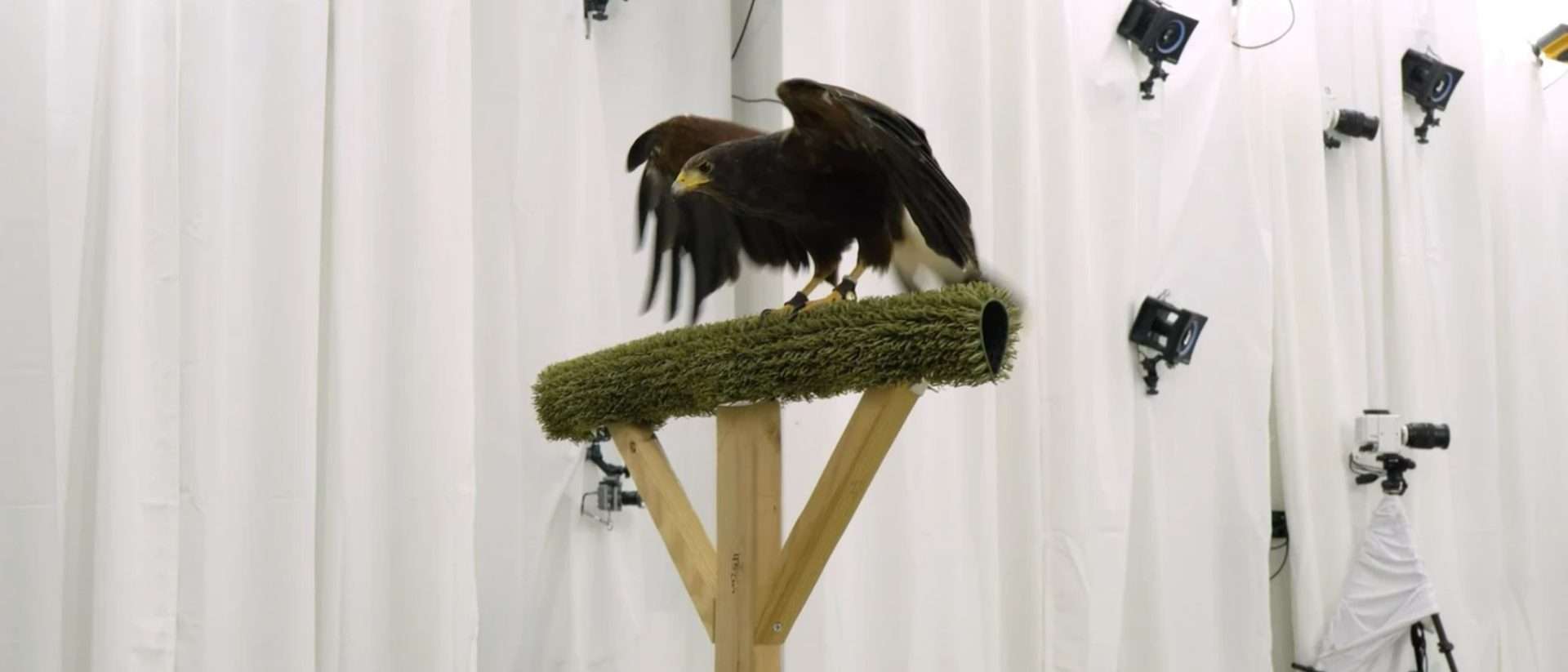
How Raptor Flight Mechanics Are Shaping the Future of Drone Design
Have you ever watched a hawk dive through the sky, pull off a sharp turn around a clump of trees, and land smoothly on a branch without breaking a sweat? It’s pretty mind-blowing. In fact, birds of prey, also known as raptors, do things in the air that make our most advanced modern aircraft look clumsy. Modern drones and airplanes are great at flying fast or staying stable, but they struggle to match the sheer speed, agility, and precision of a hunting bird. So, how do they do it? And more importantly, how can we build drones that move with the same jaw-dropping control? We will discuss raptor flight mechanics and drone design.
The Birth of CALI: Where Engineering Meets Veterinary Medicine
Back in 2026, UC Davis officially launched a super unique research hub called the Center for Animal Locomotion and Innovation (CALI).
Usually, aerospace engineers hang out with other tech folks, while veterinarians stick to animal hospitals. But CALI brings these two totally different worlds together under one roof. The center is a joint effort between:
- The UC Davis College of Engineering
- The UC Davis Weill School of Veterinary Medicine’s California Raptor Center
The whole idea started when Dr. Christina Harvey, an assistant professor of mechanical and aerospace engineering, joined forces with Dr. Michelle Hawkins, a veterinary professor and director of the California Raptor Center.
Harvey runs the Biologically Informed Research and Design (BIRD) Lab at UC Davis. She has always been fascinated by how birds outfly human technology. As Harvey puts it:
“What has always inspired me is that birds can do things that we can’t yet design aircraft to do. The goal of our research is to understand the physics-based principles of their maneuverability.”
To get this dream facility off the ground, the team received a generous grant from the U.S. Army Combat Capabilities Development Command Army Research Laboratory. This funding allowed them to build a state-of-the-art flight arena packed with high-tech sensors and cameras.
Read more: The Ultimate Guide to Reallusion AccuFACE 2
High-Tech Flight Tracking: Inside the CALI Facility for Raptor Flight Mechanics and Drone Design
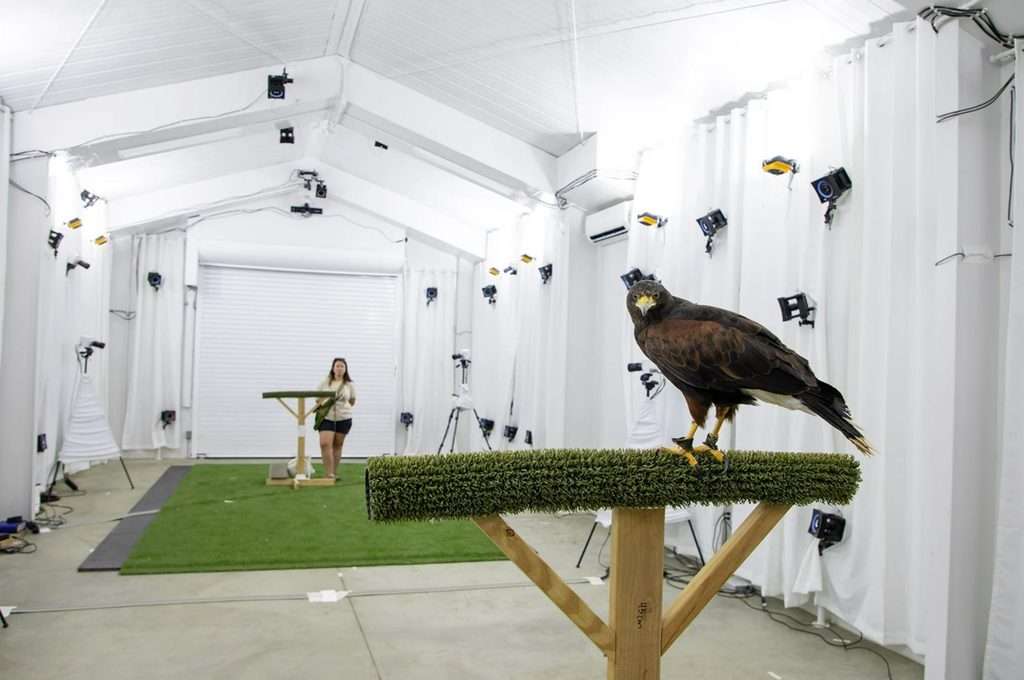
If you stepped inside the CALI research hall, you might think you were on the set of a Hollywood sci-fi movie or a video game studio.
The main flight space is roughly the size of a full basketball court. It’s equipped with specialized studio lights that recreate natural daylight, making the birds feel right at home. But the real magic lies in the tracking equipment mounted around the room.
To record high-speed bird movements that happen way too fast for the human eye, the facility uses a massive setup provided by OptiTrack:
- 9 Phantom high-speed cameras: These record at an unbelievable 1,000 frames per second at 4K resolution from several different angles.
- 44 OptiTrack VersaX 120 cameras: These 12-megapixel cameras track motion across the entire large space with sub-millimeter precision.
- 4 Prime Color cameras: These provide crisp, synchronized 1080p reference videos so researchers can double-check the raw 3D data against real footage.
How Does Motion Capture Work on a Live Bird?
You’ve probably seen motion capture (mocap) suits used in video games or movies, where actors wear dark outfits with tiny shiny balls attached to them.
The team at CALI uses a similar setup, but tailored for feathered flyers! Researchers attach tiny reflective dots to key spots on the raptors, including their wings, bodies, and tails.
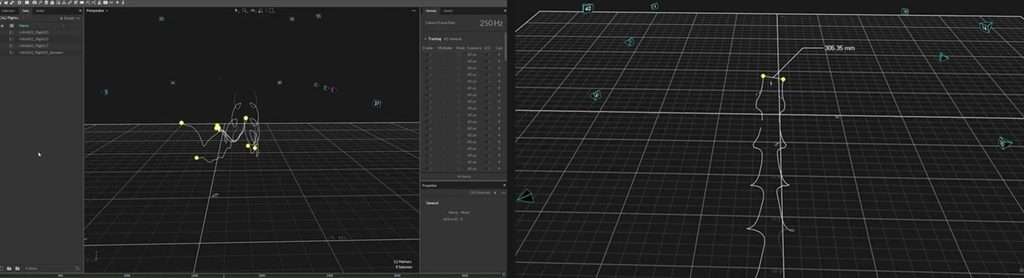
As the birds take off, fly, and land, the OptiTrack system tracks those shiny dots. The software (called Motive) calculates their exact position in 3D space, mapping out every subtle tilt, twitch, and twist of the bird’s body.
Why Is Bird Flight So Hard to Replicate?
Building an airplane or raptor flight mechanics and drone design is relatively straightforward because human-made aircraft are rigid. Their wings don’t bend, flex, or change shape mid-flight (aside from basic flaps).
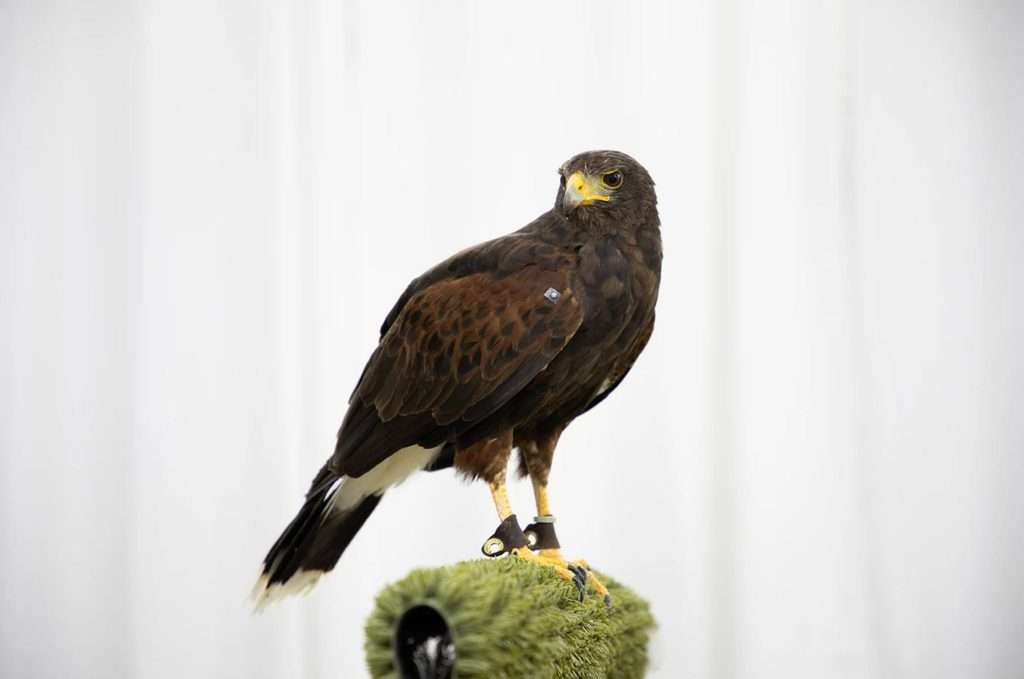
Birds, on the other hand, are wildly complex.
Dr. Harvey points out that feathers are flexible, porous, and come in unusual shapes. Plus, there are over 10,000 bird species on Earth, each evolved with different body shapes, wing styles, and flying goals. A hawk hunting in a dense forest moves very differently from an albatross gliding over the open ocean.
Because there are so many factors at play (wing shape, feather bending, tail position, air currents) it’s tricky to figure out which exact movement causes a specific flight trick.
To crack this code, the team uses a bio-informed, hypothesis-driven approach. They collect movement data from the birds and isolate each variable one by one. By breaking down the data using an engineering mindset, they can figure out which body adjustment has the biggest impact on flight performance.
Inspecting the Flight Secrets of Four Raptor Species
To uncover the core raptor flight mechanics and drone design, the research team is studying four distinct species of birds of prey, working closely with West Coast Falconry:
| Species | Known Flying Style & Traits |
| Peregrine Falcon | The ultimate speed demon; famous for high-speed hunting dives. |
| Harris’s Hawk | A highly social, agile hunter built for teamwork and smart turns. |
| Merlin | A small, fast falcon known for intense speed and quick aerial chases. |
| Goshawk | A master of woodland navigation, capable of weaving through tight trees. |
The Perch Test: Tail Spreads and Wing Angles
In one of their main experiments, researchers attach reflective markers along the edges of a bird’s tail and down its main body axis. They also place three markers along each wing.
As the bird flies across the room and comes in to land on a perch, the cameras measure:
- Tail Spread: How wide the tail fans out to create air resistance and act as a brake.
- Body Orientation: How the bird tilts its main body axis to shift its center of gravity.
- Wing Angles: How the wings fold, flex, and lift to pull off a gentle touchdown.
By comparing these measurements across different species, the researchers get an exact quantitative look at how each bird handles landing dynamics.
Future Testing: Wind Gusts and Obstacle Courses
As CALI continues to expand its testing setup, the team plans to introduce tougher challenges:
- Wind Gusts: Artificial air blasts will test how fast different birds react to unexpected turbulence.
- Obstacle Courses: Custom-built mazes will evaluate how birds dodge obstacles, helping scientists understand how they make split-second decisions in crowded spaces.
Morphing Wings: The Key to Unlocking Next-Gen Drones
One of the most exciting areas of study at CALI is wing morphology; specifically, how birds change their wing shapes during flight.

When humans design airplanes, we usually have to pick a trade-off:
- Stable Designs: Easy to control, safe, but slow to turn (like a commercial passenger jet).
- Unstable Designs: Super maneuverable, fast-turning, but hard to keep steady (like a stealth fighter jet).
Birds don’t have to choose! They can switch back and forth between stable and maneuverable wing shapes on the fly.
When a hawk needs to travel long distances, it stretches its wings wide for maximum efficiency and stability. But when it spots prey, it can instantly tuck its wings, shift its shape, and enter an unstable, hyper-maneuverable state to make hairpin turns.
Dr. Harvey believes that understanding this “morphing” process is crucial for designing future uncrewed aerial systems (UAS) and bio-inspired drones.
“Birds have an amazing degree of freedom in their wings,” Harvey notes. “One of the questions we want to answer is what level of morphing would be needed to obtain the same type of functional trajectory.”
If engineers can figure out the minimum amount of wing-bending needed to pull off complex maneuvers, we could build morphing drones that are both energy-efficient and incredibly agile.
A New Frontier for Raptor Flight Mechanics and Drone Design
While building better drones is an exciting outcome, the work at CALI isn’t just about robots and aircraft. It also offers a huge breakthrough for wildlife conservation and veterinary care.
Historically, when an injured raptor, like a hawk with a broken wing feather or a joint injury, is brought to a wildlife rescue center, veterinarians have to figure out when the bird is healthy enough to go back to the wild.
Up until now, those decisions have relied almost entirely on expert judgment:
- Watching the bird fly in a flight cage.
- Checking if it can land without stumbling.
- Relying on experience to judge whether the flight “looks” right.
While expert opinion is super valuable, it is still subjective. Different vets might have slightly different opinions on whether a bird is 100% ready.
Creating a Baseline for Healthy Flight
Thanks to the ultra-precise motion capture data collected at CALI, scientists are building a comprehensive database of healthy raptor flight patterns.
By tracking how healthy birds use their wings, bodies, and tails, researchers can establish quantitative metrics (exact numbers and measurements) for ideal flight biomechanics.
Once this database is complete, veterinarians will have an objective tool to evaluate recovering animals:
- Track Healing Progress: Vets can compare a recovering bird’s flight data against the healthy baseline for its species.
- Identify Hidden Weaknesses: The cameras can pick up tiny limps, asymmetrical wing beats, or tail imbalances that the human eye might miss.
- Make Confident Release Decisions: Vets can ensure a bird has recovered its full aerial toolkit before releasing it into the wild, giving it the best possible chance to hunt and survive.
As Dr. Harvey points out, animal flight varies quite a bit from one individual to another. Building a large, detailed database allows scientists to find overarching patterns that are true across an entire species.
The Power of Teamwork: Breaking Down Silos
Projects like CALI show what can happen when experts from completely different fields get together to solve big problems.
Instead of engineers working alone in a tech lab and wildlife experts working separately in a clinic, CALI combines both groups into a shared, collaborative space.
This effort relies on a dedicated team of researchers across the BIRD Lab and CALI, including:
- Dr. Christina Harvey: Assistant Professor, Director of the BIRD Lab, and CALI Director
- Dr. Alfonso Martinez-Carmena: Postdoctoral Scholar (BIRD Lab)
- Faiza Alvi: PhD Researcher (BIRD Lab)
- Huanglun Adam Zhu: PhD Researcher (BIRD Lab)
- Alex Fillman: PhD Researcher (BIRD Lab)
Together with the staff, volunteers, and veterinarians at the California Raptor Center, this team is proving that cross-disciplinary research can solve complex technical challenges while giving back to nature.
Summary: What Raptor Flight Mechanics Teach Us
The research happening at UC Davis is a perfect example of bio-inspired engineering; looking at nature’s design choices to solve human tech problems.
Here is a quick recap of why studying raptor flight mechanics matters:
- Advanced Drone Agility: By learning how birds morph their wings, engineers can build agile drones that navigate tight, crowded spaces like forests, cities, or disaster zones.
- Data-Driven Wildlife Rehabilitation: High-speed motion capture gives veterinarians precise 3D data to measure whether an injured bird is truly ready to return to the wild.
- Bridging Tech and Biology: Combining aerospace engineering with veterinary science opens up brand-new ways to study biomechanics and fluid dynamics.
As researchers continue to decode how raptors bend their wings, fan their tails, and ride wind gusts, we move one step closer to building flight technology that rivals nature’s best aviators.
Frequently Asked Questions
Why are raptors better flyers than modern drones?
Raptors have flexible, porous feathers and morphing wings that allow them to dynamically switch between stable cruising and hyper-maneuverable flight. Standard drones usually have rigid frames and fixed propellers, making quick maneuvers in tight spaces much harder.
What technology is used to track raptor flight at UC Davis?
Researchers at CALI use an OptiTrack motion capture system featuring 44 VersaX 120 cameras, 9 Phantom high-speed cameras shooting at 1,000 frames per second in 4K, and 4 Prime Color cameras for 1080p reference footage.
How does studying raptor flight help injured wild birds?
By recording healthy raptors in motion, scientists build a baseline database of healthy flight mechanics. Veterinarians can compare recovering birds against this data to objectively evaluate whether an animal is ready to be released back into the wild.
Source: OptiTrack

More from the stage
Sep 23, 2026Next-Level AI Facial Mocap: The Ultimate Guide to Reallusion AccuFACE 2
When Reallusion released the original AccuFACE plugin for iClone, it changed the game by offering simple, webcam-based AI facial tracking without the bulky gear. Now, AccuFACE…
Remembering Tim Curry: Celebrating the Unforgettable Legacy of a True Acting Legend
Legendary actor Tim Curry passed away at age 80. Explore his incredible life, iconic movie characters, and legendary voice-acting roles.
Start a project
Tell us what you need made.
Send us the details and we will come back within one business day with a scope and a price.
Start a project