
Inertial Motion Capture Suits: Motion Tracking Without Cameras
Tired of dealing with expensive cameras and complicated motion capture setups? Inertial motion capture suit offers a portable, wireless, and marker-free solution for animators, game developers, athletes, and even medical professionals. Using built-in sensors, these suits track movement anywhere, anytime, without the need for external equipment. Let’s explore how it works, its benefits, and which brands offer the best suits for your needs! 🚀
What is An Inertial Motion Capture Suit?
So, what exactly is an inertial motion capture suit? It’s a wearable system that tracks your movements using a network of small, high-tech sensors called IMUs (Inertial Measurement Units).

These sensors are placed at key points on your body (like your wrists, elbows, knees, and back) to capture how each part moves in real-time. Instead of relying on cameras, they measure changes in motion, acceleration, and orientation to create accurate motion data. This means you can move freely without worrying about staying inside a camera setup.
>>> Read more: How Does a Motion Capture Suit Work? Exploring Motion Capture Tech
How is it Different from Optical Motion Capture?
Traditional optical motion capture (like what you see in big-budget films) requires a studio full of cameras and reflective markers placed on the body. These cameras track the markers and use complex software to turn movement into digital animations. While this setup is super accurate, it has some major downsides: it’s expensive, requires a dedicated space, and won’t work well if objects block the cameras’ view.
An inertial MoCap suit, on the other hand, is completely self-contained. No cameras. No markers. Just wear the suit, connect it to a computer, and start moving. Because it relies on internal sensors rather than visual tracking, you can use it anywhere whether you’re in a small room, outside, or even in low-light conditions.
>>>Read more: How to create your MetaHumans with motion capture
Main Components of an Inertial Motion Capture Suit
When you put on an inertial MoCap suit, you’re basically wearing a network of smart sensors that work together to track every move you make. Here’s what makes up a typical suit:
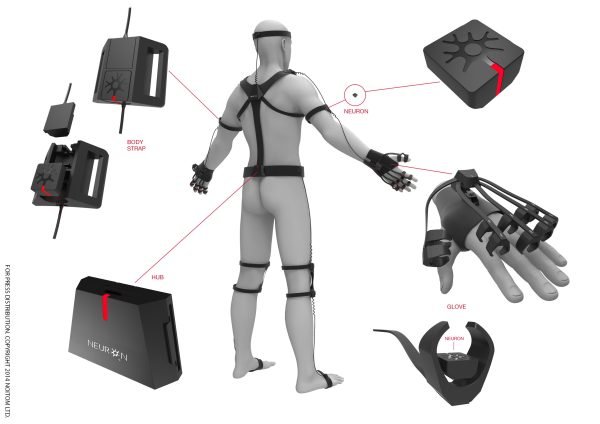
- IMUs (Inertial Measurement Units): These tiny but powerful sensors contain accelerometers, gyroscopes, and magnetometers to measure movement, speed, and orientation.
- Processing Unit: This is like the brain of the suit. It gathers raw data from the sensors, processes it, and turns it into usable motion data.
- Wireless Connectivity: Most modern MoCap suits connect wirelessly via Bluetooth, Wi-Fi, or proprietary radio signals, so you can move freely without being tethered to a computer.
- Suit Material & Fit: Some systems use full-body suits, while others rely on sensor straps you attach to your body. Either way, they’re designed to be lightweight and flexible so they don’t restrict movement.
How Inertial Motion Capture Works
Alright, now that you know what an inertial motion capture suit is, let’s break down how it actually works. Unlike optical motion capture, which needs cameras to track your movement, an inertial MoCap suit works completely on its own using built-in sensors.
Think of it like this: You put on the suit, start moving, and the sensors do all the work: tracking your body in real-time and sending that data straight to your computer. But what’s really happening behind the scenes? Let’s go step by step!

Step 1: Suit Up and Sensor Placement
Before anything else, you need to put on the suit or attach the sensors. Some systems use a full-body suit, while others have adjustable sensor straps that go on specific parts of your body, like your wrists, elbows, knees, and torso.
The key here is proper placement. If a sensor is off by even a little, the whole system can get inaccurate readings. That’s why many suits have pre-marked spots or a guide to help you place the sensors correctly. Once you’re all suited up, you’re ready for the next step!
>>>Read more: Animation vs Motion Capture: A Detailed Comparison
Step 2: Sensors Start Tracking Your Movements
At the heart of an inertial MoCap suit are tiny but powerful sensors called IMUs (Inertial Measurement Units). Each IMU contains:
- Accelerometers: These measure how fast you’re moving and in which direction.
- Gyroscopes: These track rotation, helping the system understand when you turn, tilt, or spin.
- Magnetometers: These detect orientation relative to the Earth’s magnetic field, helping keep the motion data stable.
As soon as you start moving, these sensors measure every little change in motion whether you’re walking, jumping, or waving your arms.
>>>Read more: The Future of Animation Technology: Motion Capture AI
Step 3: Data Gets Processed in Real-Time
Now that your movements are being tracked, the data needs to be processed. This is where the suit’s processing unit or your connected computer/software comes in. Here’s what happens:
- Raw sensor data is collected from each IMU on your body.
- The system combines and analyzes the data, figuring out how each body part moves in relation to the others.
- It translates that movement into a 3D digital model, creating a real-time animated version of you!
Step 4: Wireless Data Transmission
Most modern suits don’t need cables, they transmit data wirelessly using Bluetooth, Wi-Fi, or special radio signals. This means you can move freely without worrying about tripping over cords.
Your motion data is sent to a computer, VR system, or cloud-based server, where it can be:
- Recorded for later editing (for animation or analysis)
- Used in real-time for game development, VR, or live-action performances
- Analyzed for biomechanics, sports science, or medical applications
Step 5: Calibration for Accuracy
Before you start a MoCap session, you usually need to calibrate the suit. This step helps the system understand:
- Your body proportions (since everyone’s different)
- Your default stance or starting position
- How the sensors should interpret your movement
Calibration is often as simple as standing still in a T-pose or following a few basic movements (like bending your knees or rotating your arms). This helps the system adjust and ensures more accurate tracking.
Advantages of Inertial Motion Capture Suits
Inertial motion capture suits have completely changed the game for animators, game developers, and researchers. Unlike traditional optical MoCap, these suits don’t rely on cameras or markers, giving you more freedom and flexibility when capturing movement.

No Need for Cameras or Markers
One of the biggest perks is that you don’t need an entire studio filled with cameras. Optical motion capture requires high-end cameras, perfect lighting, and reflective markers that can easily lose tracking. Inertial suits, however, track everything internally using built-in sensors, so there’s no need for external equipment. This means no special room, no expensive setup, and no worrying about losing tracking when something blocks the view.
Use It Anywhere, Anytime
Because inertial suits don’t rely on cameras, you’re not limited to a controlled studio environment. You can use them indoors, outdoors, in small spaces, or even in the dark. Whether you’re animating characters, capturing movements for a VR experience, or analyzing athletic performance, these suits work wherever you need them to.
Quick and Easy Setup
Setting up an optical MoCap system can take hours; placing cameras, calibrating markers, and making sure the environment is perfect. With an inertial suit, the setup is much faster. Strap on the sensors, connect wirelessly, do a quick calibration, and you’re ready to go. No more wasted time adjusting cameras or troubleshooting tracking issues.
Real-Time Motion Tracking
Since all the motion data is processed instantly, you can see your movements reflected in real time. This is a huge advantage for live performances, VR applications, and game development, where instant feedback is crucial. Instead of waiting for post-processing, you can watch your character move as you do and make adjustments on the fly.
More Affordable Than Optical MoCap
Professional optical MoCap systems can cost hundreds of thousands of dollars, making them out of reach for small studios or independent creators. Inertial suits, while still an investment, are much more budget-friendly. There are options for different price ranges, from entry-level models for indie developers to high-end systems used in professional animation and biomechanics.
Works in Any Lighting or Environment
Since inertial suits don’t rely on visual tracking, they work perfectly in low-light conditions or even in crowded spaces. You don’t have to worry about markers being blocked or reflections messing with the data. Whether you’re recording in a dimly lit studio or moving through a cluttered environment, the sensors keep tracking your movements accurately.

Wireless and Comfortable to Wear
Most inertial motion capture suits are wireless, which means no cables getting in the way. You can move naturally without being restricted by wires or fixed positions. The suits themselves are designed to be lightweight and flexible, so you can focus on your movements rather than feeling uncomfortable or restricted.
Limitations of Inertial Motion Capture
While inertial motion capture suits offer flexibility and ease of use, they have some limitations.
One major issue is drift errors, where small inaccuracies build up over time, causing misalignment in movement. Additionally, magnetic interference from metal objects or electronics can affect sensor accuracy, leading to tracking errors.
Unlike optical MoCap, inertial suits don’t track absolute position in a space; they only record relative movement. This makes them less effective for applications that require precise location tracking, like VR interactions. They also lack the fine precision of high-end optical systems, struggling with subtle movements like detailed facial expressions or intricate finger tracking.
Though generally more affordable than optical MoCap, high-end inertial suits can still be expensive, with costs ranging from $1,500 to over $10,000. Additionally, these suits may struggle with extreme or high-speed movements, leading to slight inaccuracies in fast actions like jumps or spins.
Despite these drawbacks, inertial motion capture remains a powerful, portable, and cost-effective solution for animation, VR, biomechanics, and more.
Applications of Inertial Motion Capture Suits
Inertial motion capture suits are used across industries, from game development to sports science and medical research.
- In gaming and animation, they help create realistic character movements without the need for expensive optical setups. Indie developers and animators can easily capture motion anywhere.
- In VR and AR, these suits enable full-body tracking, making virtual experiences more immersive, whether for gaming, fitness, or simulations.
- Hollywood and live performances use MoCap suits for pre-visualizing action scenes and bringing digital avatars to life on stage.
- In sports science, they analyze athletes’ posture, movement, and performance, helping with training and injury prevention.
- The medical field uses motion capture to study gait disorders, physical therapy progress, and rehabilitation. Since these suits are wireless, they allow real-world movement tracking, not just lab-based studies.
- In robotics and industrial training, they help engineers program humanoid robots and allow workers to train in virtual environments for safety.
Popular Inertial Motion Capture Suit Brands
If you’re looking to get into motion capture, choosing the right suit is a big deal. There are several brands out there, each with different features, pricing, and levels of accuracy. Let’s take a look at some of the most popular inertial motion capture brands and what they offer.
Xsens – The High-End Professional Choice
If you need top-tier accuracy and don’t mind paying for it, Xsens (now part of Movella) is one of the best options out there. Their suits are widely used in AAA game development, film production, biomechanics, and sports science.

Why Choose Xsens?
- Extremely accurate tracking with minimal drift
- Robust software that integrates with Unreal Engine, Unity, and more
- Great for biomechanics and professional animation
Price Range: $10,000+ for a full setup
If you’re working at a studio-level production and need ultra-precise motion data, Xsens is the way to go.
Rokoko Smartsuit Pro – The Best for Indie Creators
If you’re an indie developer, animator, or small studio, Rokoko’s Smartsuit Pro is one of the most popular choices. It’s an affordable, wireless, and easy-to-use MoCap suit designed for creators who want high-quality results without breaking the bank.
Why Choose Rokoko?
- Affordable compared to high-end suits
- Wireless and portable, use it anywhere
- Easy integration with 3D software like Blender, Unity, and Maya
Price Range: $2,500 – $4,000
It’s a fantastic choice if you want real-time animation, live streaming, or game development without needing a Hollywood-sized budget.
Perception Neuron – The Most Flexible MoCap System
Perception Neuron by Noitom is known for its modular approach—instead of a full-body suit, you get individual IMU sensors that you can attach to different parts of your body. This makes it super flexible and customizable, whether you need basic hand tracking or full-body capture.

Why Choose Perception Neuron?
- Scalable; start with a few sensors and expand later
- Budget-friendly entry-level options
- Great for VR, gaming, and biomechanics
Price Range: $1,500 – $5,000 depending
If you like the idea of customizing your MoCap setup, this brand gives you a lot of control over your system.
Movella (formerly Xsens Motion) – Precision for Biomechanics & Sports Science
Movella focuses on high-precision MoCap for biomechanics, sports, and medical research. Their suits offer detailed movement analysis, making them great for athletic performance tracking, medical studies, and research applications.
Why Choose Movella?
- Industry-leading accuracy for biomechanics & research
- Great for medical applications and sports tracking
- Advanced data analytics tools for detailed movement analysis
Price Range: Pricing varies by setup
If you’re working in healthcare, rehabilitation, or sports science, Movella’s suits are built specifically for these fields.
Noitom Motion Capture – Affordable & Versatile MoCap Solutions
Noitom offers several MoCap solutions, including budget-friendly options like Perception Neuron and high-end systems for virtual production, gaming, and industrial training. Their suits are used in everything from VR applications to Hollywood productions.

Why Choose Noitom?
- Wide range of products for different budgets
- Good for both animation and industrial training
- Offers face and hand-tracking options
Price Range: Affordable to high-end options available
Noitom is a solid choice if you want affordable MoCap without sacrificing too much accuracy.
Which MoCap Suit is Right for You?
Choosing the right inertial motion capture suit depends on your budget and what you need it for:
- If you need professional, high-accuracy motion capture, Xsens or Movella is the best choice.
- If you’re an indie creator or game developer, Rokoko Smartsuit Pro gives you the best balance of price and quality.
- If you want a flexible and modular system, Perception Neuron is a great option.
- If you need motion capture for biomechanics or sports, Movella is your best bet.
No matter what you choose, inertial motion capture is becoming more accessible than ever, letting you bring high-quality motion tracking into your projects without a massive Hollywood budget.
Conclusion
Inertial motion capture suits are revolutionizing motion tracking by offering wireless, portable, and camera-free solutions for animation, gaming, VR, sports, and medical applications. With brands like Xsens, Rokoko, and Perception Neuron, there’s a suit for every budget and need. Whether you’re a creator, athlete, or researcher, this technology makes motion capture more accessible than ever. Ready to bring your movements to life?
–
Animost – Vietnam 3D Animation Studio


hello@animost.com

More from the stage
Sep 15, 2026Behind the Scenes of HOPE Na Hong-jin Sci-Fi Action with Motion Capture
If you love wild action movies, high-stakes science fiction, and cinema that keeps your heart pounding, South Korean filmmaker Na Hong-jin’s latest project, HOPE, needs to…
Do I Own the Copyright to AI-Generated Animation?
Do you own the copyright to AI-generated animation? Learn how AI, human creativity, and platform rules affect ownership and commercial rights.
Start a project
Tell us what you need made.
Send us the details and we will come back within one business day with a scope and a price.
Start a project