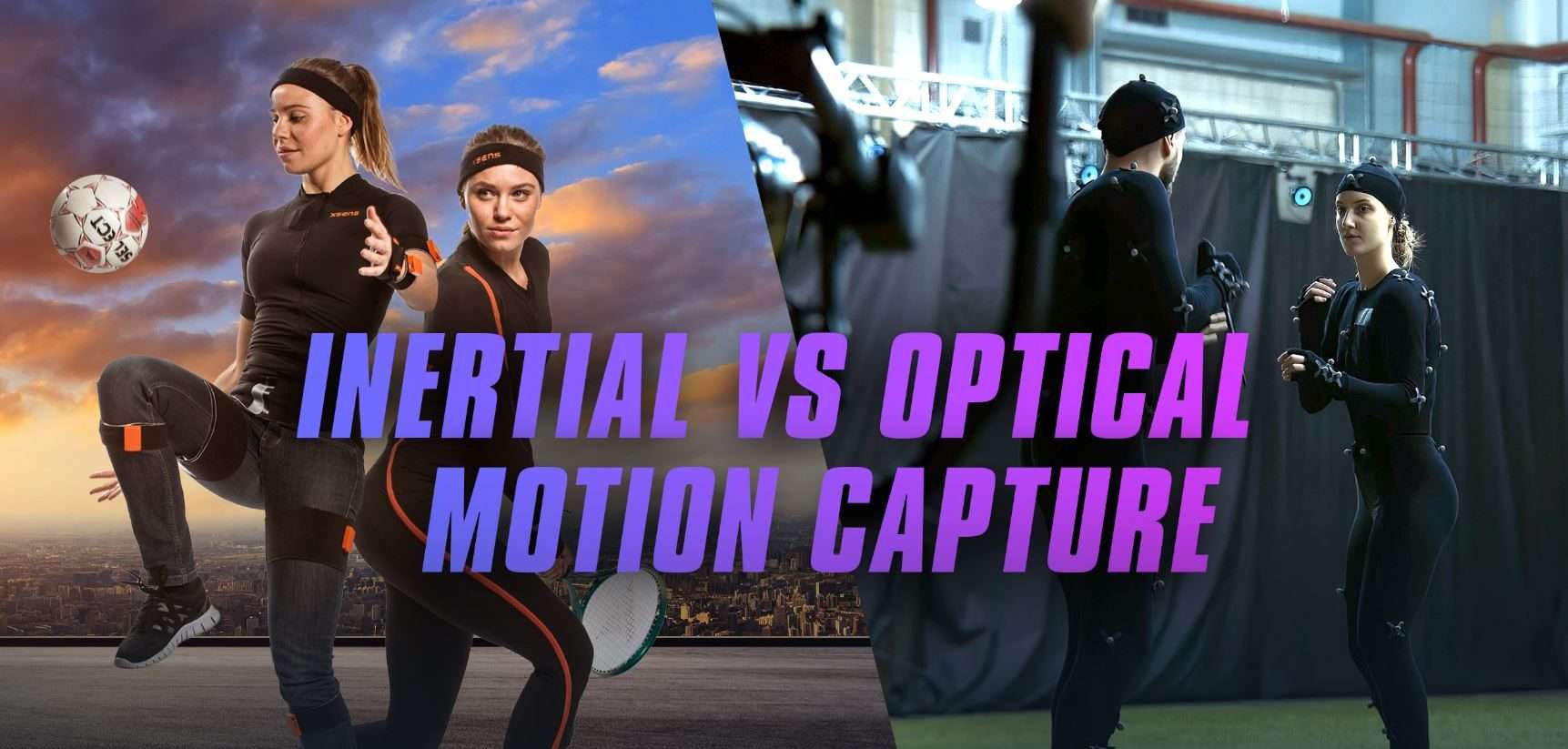
Optical vs Inertial Motion Capture: Which is Right for Your Project?
When you’re deciding between optical vs inertial motion capture system, it’s all about figuring out what fits your project best. Both are popular in industries like movies, video games, and sports, but they come with different perks and trade-offs.
Your choice depends on what’s more important: pinpoint accuracy or flexibility and budget-friendliness! Read on to find out!
Optical vs Inertial Motion Capture

Here’s a detailed head-to-head comparison between Optical and Inertial Motion Capture systems:
| Aspect | Optical Motion Capture | Inertial Motion Capture |
| Technology | Utilizes multiple cameras to track reflective or LED markers on the subject’s body | Uses IMUs (Inertial Measurement Units) including accelerometers, gyroscopes, and magnetometers to track movement |
| Accuracy | Extremely high, with sub-millimeter precision; ideal for high-end film and games requiring detailed motion | Moderate accuracy; can suffer from drift over time, especially in long sessions. |
| Occlusion | Prone to occlusion; if a marker is blocked by body parts or objects, the system may lose track | No occlusion issues since sensors are attached directly to the actor’s body, allowing continuous tracking. |
| Tracking Space | Limited by camera view and requires a controlled, often large space; best in studio environments | Highly flexible; can operate in any environment, indoors or outdoors, without constraints on space. |
| Set-up Complexity | Requires extensive setup including multiple cameras, calibration, and optimized lighting; time-consuming | Quick to set up, as IMUs are worn by the actor, requiring minimal calibration and no special environment. |
| Real-Time Applications | Typically requires post-processing; real-time data is possible but more complex and less common | Supports real-time tracking and live-streaming of data, making it more suited for real-time applications. |
| Cost | High cost due to the number of cameras, processing power, and space required | Generally lower cost, especially for indie studios or smaller productions. |
| Maintenance & Calibration | Requires regular maintenance of cameras and recalibration when markers are misaligned | Occasional recalibration needed during long sessions due to drift, but less frequent than optical systems. |
| Best Use Cases | High-end film, game production, and sports performance analysis where precision is key | Indie studios, real-time applications, and remote settings where portability is a priority. |
Summary:
- Optical MoCap provides extremely precise data but is expensive and requires controlled environments, making it best suited for high-end projects.
- Inertial MoCap is more portable, cost-effective, and ideal for real-time tracking, though it may lack the fine accuracy of optical systems, especially over long sessions.
Which System Offers Better Value for Your Needs?

The best motion capture system for you depends on your specific needs and budget.
Optical motion capture offers superior accuracy, making it ideal for high-budget projects in film, gaming, and sports where precision is key. This system is well-suited for environments where controlled lighting and space are available, such as studios.
However, it is more expensive and complex to set up, requiring multiple cameras, large spaces, and time for calibration. If your project demands high detail and precision, and budget is not a major concern, optical motion capture is the better choice.
Inertial motion capture, on the other hand, provides excellent value for smaller studios, indie game developers, and projects with real-time requirements.
It is far more affordable, portable, and faster to set up. Inertial systems don’t need special environments, making them versatile and ideal for outdoor or remote locations.
While they may lack the extreme accuracy of optical systems and are prone to drift over time, their flexibility and real-time capabilities make them a great option for many users.
If your project prioritizes cost-efficiency, ease of use, and flexibility, inertial motion capture offers better value.
So, think about what’s most important—accuracy, cost, or convenience—and you’ll find the right fit!
–
Animost – Vietnam 3D Animation Studio


hello@animost.com

More from the stage
Sep 15, 2026Behind the Scenes of HOPE Na Hong-jin Sci-Fi Action with Motion Capture
If you love wild action movies, high-stakes science fiction, and cinema that keeps your heart pounding, South Korean filmmaker Na Hong-jin’s latest project, HOPE, needs to…
Do I Own the Copyright to AI-Generated Animation?
Do you own the copyright to AI-generated animation? Learn how AI, human creativity, and platform rules affect ownership and commercial rights.
Start a project
Tell us what you need made.
Send us the details and we will come back within one business day with a scope and a price.
Start a project