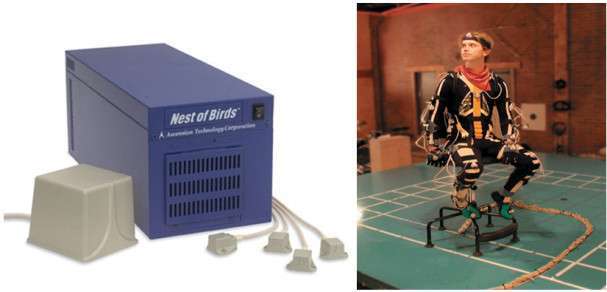
Magnetic Motion Capture: What It Is and How It Works
When you think of motion capture, your mind probably jumps to actors in tight suits covered in shiny dots, right? Yeah, the classic movie-set look. But mocap isn’t a one-size-fits-all deal. There are several different ways to track movement, and one of the most innovative (and oldest) is magnetic motion capture, also known as electronic magnetic motion capture.
In this article, we’re breaking down what magnetic mocap is, how it works, when it’s useful, when it’s not, and why it still has a place even with all the high-tech optical and markerless systems out there.
So, What Exactly Is Magnetic Motion Capture?
In the simplest terms, magnetic motion capture uses magnetic fields to track sensors that you place on a performer or object.
Here’s the quick version:
- You have a transmitter that creates a magnetic field.
- You attach small sensors (receivers) to the person or object you want to track, usually at the joints or limbs.
- The system measures how each sensor interacts with that magnetic field.
- Then, it figures out the position and orientation of every sensor in real time.
Boom! You’ve got digital motion data that shows exactly how someone (or something) moves.

Unlike camera-based motion capture (MOCAP), magnetic systems don’t require consideration of lighting or line of sight. That means you can still get clean motion data even when your actor is holding props, turning around, or blocking their own limbs.
Pretty handy, right?
Why People Still Use Magnetic Motion Capture
Alright, let’s get into the good stuff: why would anyone choose magnetic mocap when we’ve got fancy optical and inertial systems everywhere? Turns out, it has some unique strengths.
It Doesn’t Care About Line of Sight
No cameras. No light setups. No “oh no, their hand blocked the marker!” moments.
Magnetic mocap doesn’t rely on cameras, so you can record motion even when limbs overlap or props get in the way. It’s awesome for capturing close interactions; think picking up objects, opening doors, or working with tools.
>>> Read more: 4 Main Types Of Motion Capture Systems You Should Know
It Nails Orientation Data
Each sensor can track its own position and rotation, which means you get strong orientation data with fewer sensors. If you’ve ever struggled with joint twisting in other mocap systems, you’ll appreciate this a lot.
Lighting Doesn’t Matter
Because magnetic tracking has nothing to do with light, you can record in dark rooms, weird lighting, or even flashing environments; no problem.
>>> Read more: Important things to know when implementing Motion Capture with a budget
Works Well in Small, Confined Spaces
No giant camera rigs or fancy stages. If you’ve got a tight workspace, a magnetic setup can fit right in. It’s one of the few mocap systems that actually performs well in small areas.
Great for Specialized Fields
Magnetic mocap isn’t just for animation or games. It’s used in medicine, robotics, and VR/AR tech too.
For example:
- Surgeons use it to track surgical tools inside the body.
- Robots use it to sense joint angles and arm positions.
- AR developers use it for accurate hand tracking when cameras can’t see everything.
But It’s Not Perfect: The Downsides of Magnetic Mocap
Alright, time for some real talk: magnetic mocap isn’t all sunshine and smooth tracking. There are a few big catches you should know before diving in.\

It Hates Metal (and EM Interference)
The biggest issue? Interference.
Metal objects, wires, and anything that gives off electromagnetic noise can mess with the magnetic field. Even stuff like rebar in walls can throw off your data.
That means you’ll need to set up in a metal-free zone or do some serious shielding to keep readings clean. Some studios even record in open rooms or special non-metal setups to get accurate results.
>>> Read more: Is Motion Capture Expensive? How To Reduce The Cost Of Motion Capture?
Limited Range
The further your sensors are from the transmitter, the weaker the magnetic field gets. So magnetic mocap usually works best in smaller spaces. If you’re trying to capture a full dance scene across a huge stage. Yeah, this isn’t your best option.
Calibration Is a Must (and Often)
You’ll need to calibrate often. Over time, drift and small misalignments can build up. Even moving props or someone walking too close with a metal phone in their pocket can cause errors.
So plan for regular recalibrations, especially during long recording sessions.
>>> Read more: How Accurate Are Mocap Suits? A Dive into Motion Capture Precision
Not Great for Multiple Actors
Magnetic mocap doesn’t handle large groups well. If multiple actors (each with sensors) are close together, their fields can interfere. The result? Messy, unreliable data.
Noise Filtering Adds Latency
To deal with interference, the system filters out noise. That’s great for stability, but filtering can also introduce lag; not ideal for real-time applications like live VR performance.
Some Systems Still Use Wires
Depending on the model, sensors might be wired or tethered to the receiver unit. That can restrict movement or add setup hassle. Wireless models exist, but they’re pricier and need strong battery management.
Magnetic Mocap vs. Other Mocap Systems
Let’s see how magnetic mocap stacks up against the other main types: optical, inertial, and markerless systems.
| Mocap Type | The Good | The Bad |
| Optical (marker-based) | Super accurate, can handle large spaces, great visuals | Needs tons of cameras, hates occlusion, expensive setup |
| Inertial (IMU-based) | Portable, no cameras, works anywhere | Suffers from drift over time, less accurate without correction |
| Markerless (AI/vision-based) | No suits or sensors needed, easy setup | Lighting-sensitive, less precise, struggles with complex scenes |
| Magnetic | No occlusion, great rotation data, small-space friendly | Metal interference, short range, needs frequent calibration |
So, think of magnetic mocap as your specialist. It’s not for every project, but when you need reliable rotation data in tight or occluded environments, it shines.
Real-Life Uses of Magnetic Motion Capture
Let’s take a look at some actual scenarios where magnetic mocap works really well.
Capturing Hands and Tools
When someone’s working with tools or props, maybe screwing in bolts, writing with a pen, or operating a machine, optical systems struggle because everything’s in the way. Magnetic mocap? It doesn’t care. It keeps tracking even when parts are hidden.
Medical and Surgical Tracking
Doctors use magnetic tracking to follow surgical instruments inside the human body. Since cameras can’t see inside, magnetic sensors are perfect for internal tracking. These sensors are tiny, accurate, and can even handle robotic assistance during surgery.
Robotics and Industrial Work
Magnetic tracking is awesome for robotics. It gives machines a sense of where their joints and tools are in space; crucial for precision tasks in manufacturing or automation.
AR and VR
In AR or VR, you want natural movement, especially for hands or props that might get blocked by headsets or furniture. Magnetic sensors can help by tracking motion even when vision systems lose sight of your hands.
Research and Biomechanics
For scientists studying how humans move. Say, in rehab research or athletic training, magnetic mocap works well in small lab spaces where optical setups don’t fit.
How to Get the Most Out of Magnetic Mocap
If you’re planning to use (or build) a magnetic mocap system, here are a few tips to make your life easier.
Pick Quality Hardware
Not all systems are equal. Go for gear that has strong shielding, adaptive filtering, and good calibration tools. A few extra dollars here will save hours of frustration later.
Keep Metal Far, Far Away
Seriously. Metal is your worst enemy. Clear your recording zone of metal tables, wires, and heavy electronics. Even steel beams in walls can cause trouble, so test your space before setting up.
Calibrate Often
Always start with a calibration pose, and recalibrate throughout your session if you notice drift. It’s a small habit that saves a ton of cleanup time in post-processing.
Secure Your Sensors
Make sure sensors stay tight and don’t slide around on your suit or straps. Even tiny movements can mess up your readings.
Combine It with Other Systems
The best results often come from hybrid mocap setups. For example:
- Use magnetic sensors for hands and props.
- Add inertial sensors for body movement.
- Combine both in software for clean, drift-free data.
This combo helps you get the best of both worlds: accuracy plus flexibility.
Know Your Boundaries
Stay within your system’s effective range and avoid large metal props or areas with strong electric devices. Keep your performance zone as interference-free as possible.
When Magnetic Mocap Isn’t the Best Choice
Even though it’s a cool technology, magnetic mocap isn’t ideal for every situation. Here’s when you might want to look elsewhere:
- You need to capture multiple actors at once.
- You’re working in a metal-heavy environment.
- You need a large capture area or an outdoor setup.
- You’re recording super fast motion (like combat or sports).
- You want minimal maintenance and calibration.
In those cases, an optical or inertial system (or a mix) might serve you better.
The Future of Magnetic Motion Capture
You might be wondering, with all the new tech around, is magnetic mocap dying out? Nope. It’s actually evolving quietly in the background.
Here’s what’s on the horizon:
- Smaller, smarter sensors that resist interference better.
- AI-powered data fusion, blending magnetic, optical, and inertial data for cleaner results.
- Improved shielding and calibration tools that make setup faster.
- Medical and robotic use cases are growing fast, from surgical navigation to micro-robot tracking.
So yeah, magnetic mocap is definitely here to stay. It might not dominate blockbuster movie sets, but it’s quietly powering tech in labs, hospitals, and next-gen AR tools.
Quick Example: How a Studio Might Use Magnetic Mocap
Imagine you’re building a VR experience where players use real tools in a virtual workshop. You need accurate hand and tool tracking, but the environment is cluttered; perfect for magnetic mocap.
Here’s what your setup might look like:
- Mount one or two transmitters near your workspace.
- Attach sensors to the player’s hands, wrists, and tools.
- Clear out metal furniture and electronics.
- Calibrate once, then capture the player’s interactions.
- Blend magnetic data with inertial sensors for smooth motion.
- Import the cleaned-up data into your VR engine.
You’d get realistic movement and interaction without worrying about occlusion or lighting; exactly what magnetic mocap is made for.
So, Should You Use Magnetic Motion Capture?
Here’s the short version:
Use it if:
- You need solid rotation tracking.
- You’re working in a small, controlled space.
- You’re capturing close, occlusion-heavy actions.
- You’re okay with frequent calibration.
Avoid it if:
- You’ve got a metal-heavy environment.
- You need to track multiple actors or a large stage.
- You want a plug-and-play system that “just works” everywhere.
When used in the right setting, magnetic motion capture can deliver smooth, accurate, and visually rich motion data, especially for hands, props, and small-scale scenes.
Final Thoughts
At the end of the day, magnetic motion capture is like that quiet workhorse tool; it doesn’t get as much spotlight as optical systems, but it’s incredibly useful when you need it.
It’s accurate, compact, and doesn’t care if your scene is full of occlusions or tricky lighting. Just treat it right (keep it away from metal, calibrate often, and pair it with other systems), and you’ll get fantastic motion data for your projects.
So whether you’re building a VR experience, running a robotics lab, or experimenting with new motion tech, give magnetic mocap a shot. It might surprise you how capable it still is.
–
Animost – Vietnam 3D Animation Studio


hello@animost.com

More from the stage
Sep 15, 2026Behind the Scenes of HOPE Na Hong-jin Sci-Fi Action with Motion Capture
If you love wild action movies, high-stakes science fiction, and cinema that keeps your heart pounding, South Korean filmmaker Na Hong-jin’s latest project, HOPE, needs to…
Do I Own the Copyright to AI-Generated Animation?
Do you own the copyright to AI-generated animation? Learn how AI, human creativity, and platform rules affect ownership and commercial rights.
Start a project
Tell us what you need made.
Send us the details and we will come back within one business day with a scope and a price.
Start a project